Two lakes and three giants
Turquoise Lake Brienz, deep-blue Lake Thun and the Eiger–Mönch–Jungfrau wall fill one panorama. The lake colour comes from glacial rock flour; the peaks top 4,000 m.
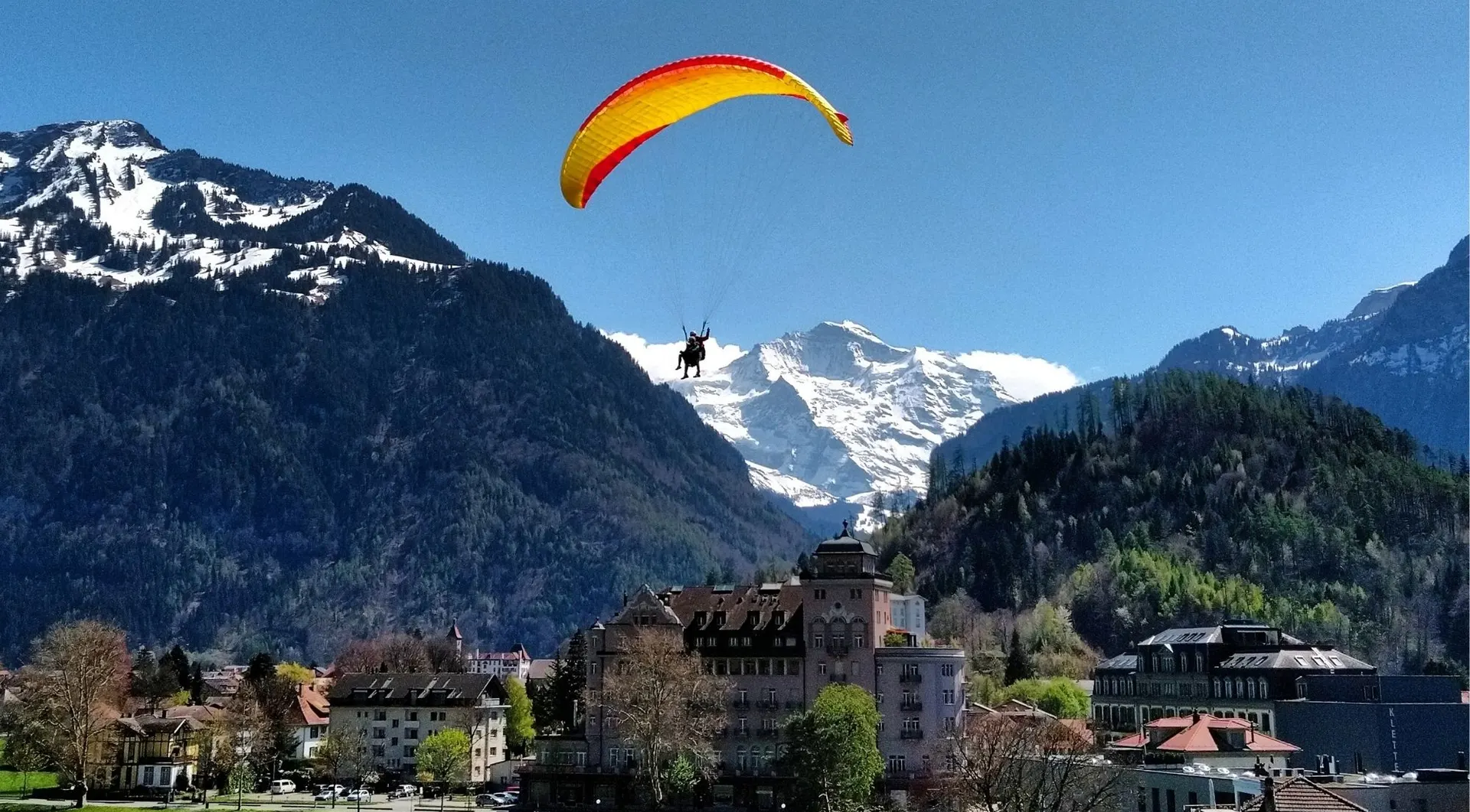
For most visitors, flying over Interlaken is the highlight of the whole trip — and many who arrive set on skydiving end up rating the paraglide higher, because gliding gives you the time to actually take in the view. The town sits at 566 m between Lake Thun and Lake Brienz, with the Eiger, Mönch and Jungfrau rising behind it, so you are not just booking an adrenaline activity — you are booking one of the most complete views in the Alps: two turquoise lakes, a green valley town, and a wall of 4,000 m peaks in a single field of view.
The choice comes down to two very different flights. Paragliding is the gentler, more scenic option: after a short drive up to the launch above town, you run a few steps and lift off for a calm 10–20 minute glide that lands in Höhematte park in the centre of Interlaken. Skydiving is the bigger thrill — a ~45-second freefall from 4,000 m before a canopy ride over the Bernese Alps. Both are run by licensed operators with strong safety records. One piece of advice matters more than any other: book your flight for the first or second day of your trip, never the last, so weather has room to cooperate.
Flying is just the start in Interlaken and the wider Jungfrau region. Alongside tandem paragliding in Interlaken and airplane skydiving over the Swiss Alps from Reichenbach, travellers pair their flight with the Mürren paragliding panorama tandem flight, a trip up to Jungfraujoch – Top of Europe, a cruise on Lake Thun or Lake Brienz, and a day exploring Grindelwald or the Harder Kulm viewpoint above town.
From the meeting point on Höheweg to a stand-up landing in the park — here's how the ~1.5-hour experience unfolds.
Check in at the operator's desk on or near Höheweg, the main promenade between Interlaken West and Ost. You'll meet your pilot, sign in, and be fitted for boots and a jacket if you need them — everything is provided.
A ~20-minute minibus ride climbs to the Beatenberg / Amisbühl launch at around 1,300–1,350 m, on the slopes below the Niederhorn. The road itself opens up the first big views over the valley.
A short safety briefing, helmet and harness fitting, and a few words on the take-off. No experience is needed — your pilot does the flying; you just need to run a few steps when they say go.
A few running steps down a gentle meadow and the canopy lifts you off. For 10–20 minutes you glide ~800 m down — Eiger, Mönch and Jungfrau on one side, both lakes and the town on the other. Ask for calm, or for dynamic spiral tricks.
You touch down — usually a soft few steps or a stand-up — on the Höhematte field in the centre of town. Photos and video, filmed by your pilot on a GoPro pole, are available to buy on the spot.
The classic Interlaken flight — flown by Skywings-style competition pilots, rated 4.9 across 2,600+ reviews, and the best balance of view, airtime and price.
Why we recommend it: it launches from the established Beatenberg/Amisbühl site, lands right in Höhematte park in town, and includes transfer, all equipment and a qualified pilot — at the standard tandem price rather than a premium. Ideal for first-time flyers and anyone nervous about heights.
Digital photos and videos are an optional on-site add-on (about CHF 40). Reserve now, pay later with free cancellation up to 24 hours before.
Secure your slot and pay later — morning slots fill quickly in summer. Free cancellation up to 24 hours before.
Check availability & pricesReserve now, pay later · licensed Interlaken operators via GetYourGuide
Plenty of places offer mountain flying. Interlaken combines three things almost nowhere else does — in a single descent.
Turquoise Lake Brienz, deep-blue Lake Thun and the Eiger–Mönch–Jungfrau wall fill one panorama. The lake colour comes from glacial rock flour; the peaks top 4,000 m.
You take off from the hills above Interlaken and land in Höhematte park near the promenade — so the flight feels part of the town, not hidden away in the mountains.
Ringed by high peaks, the Interlaken bowl has unusually stable flying conditions and a 35-year tradition of professional tandem operations.
Direct trains run ~2 hours from Zurich and Lucerne and ~2.5–3 hours from Geneva, with short transfers to the launch sites once you're in town.
Two very different ways to take to the air. Here's the headline option for each — compare them in detail further down.
A 10–20 minute glide with a licensed tandem pilot, launching above town and landing in Höhematte. Suitable for nervous first-timers and a wide range of ages — the airtime to actually take in the view is what makes it most people's highlight. New to it? Read our complete guide to paragliding in Interlaken.
See the featured flight →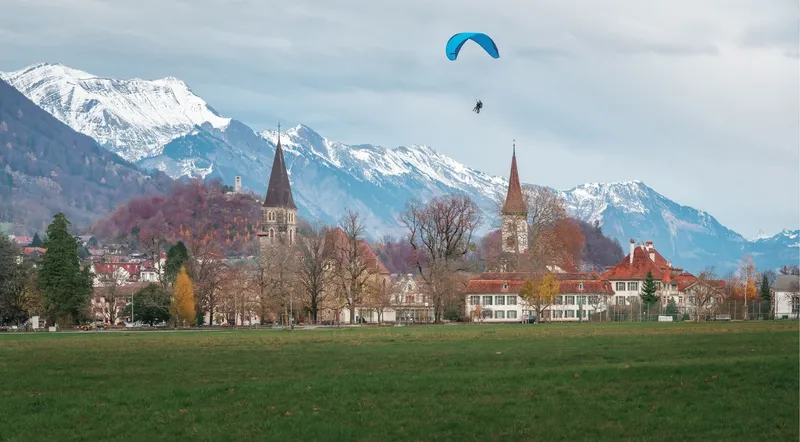
An airplane tandem jump with ~45 seconds of freefall at 200 km/h, then a 5–7 minute canopy ride over the Bernese Alps, landing at the Reichenbach airfield. Pure thrill — book this if the freefall itself is the reason you're flying.
See the skydive numbers →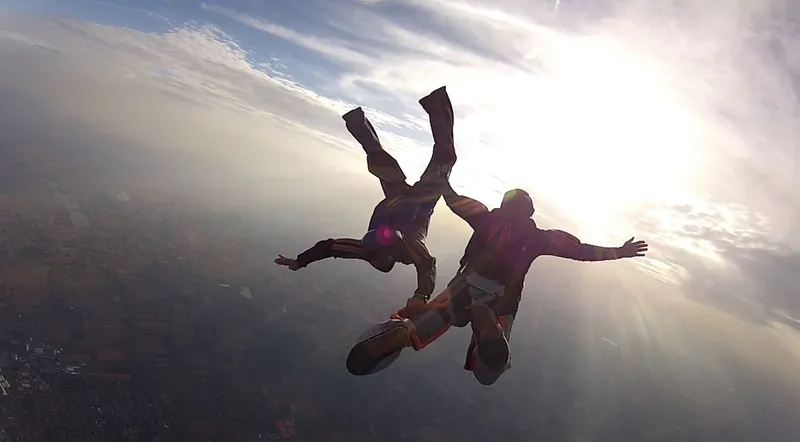
Real conditions over the lakes, the valley and the Jungfrau wall — paragliding and skydiving.
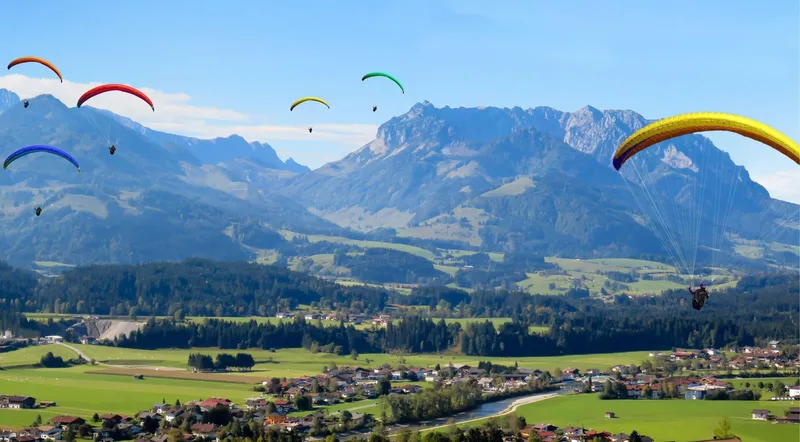
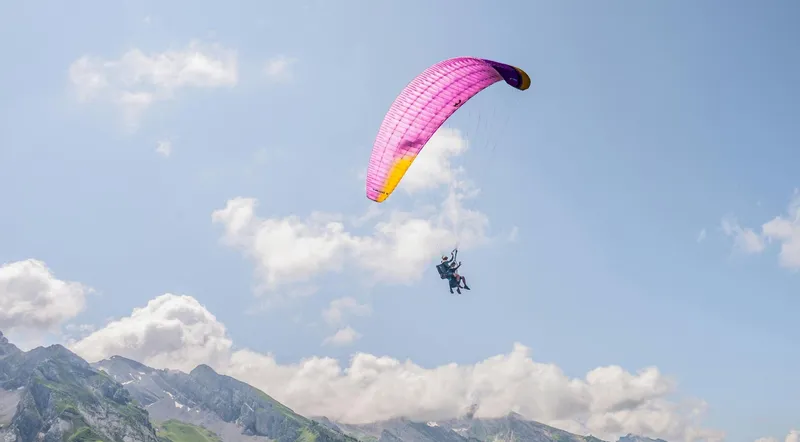
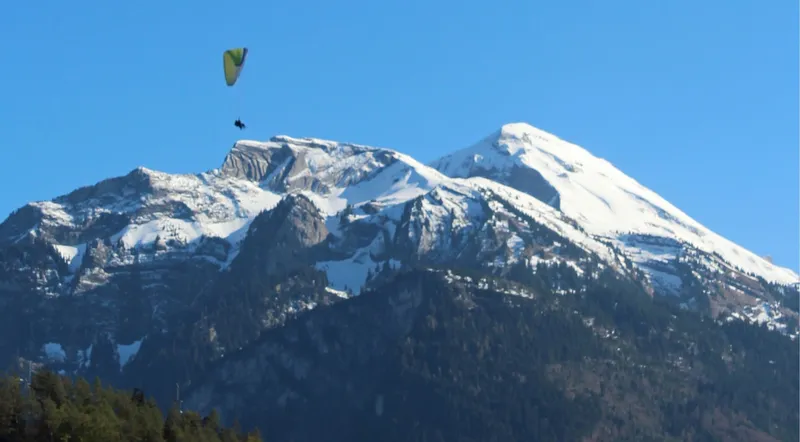
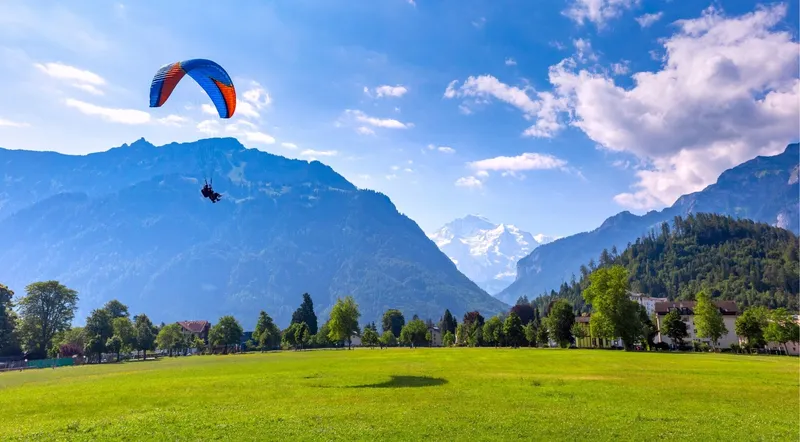
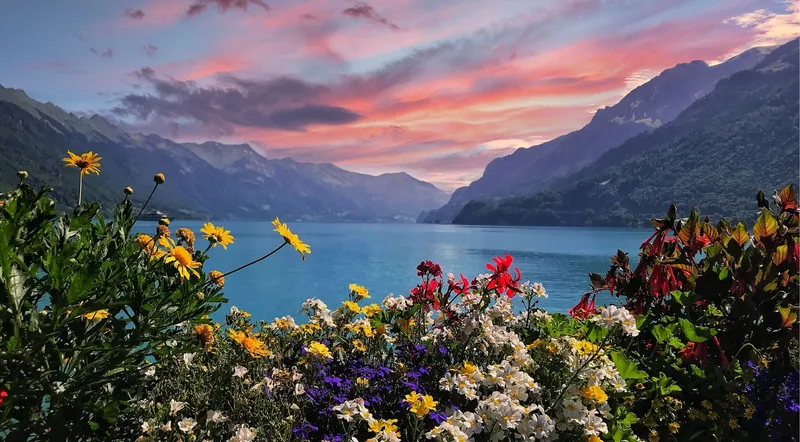
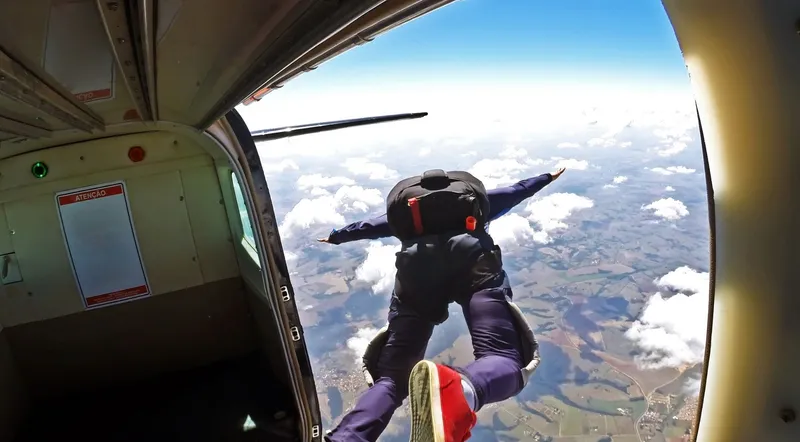
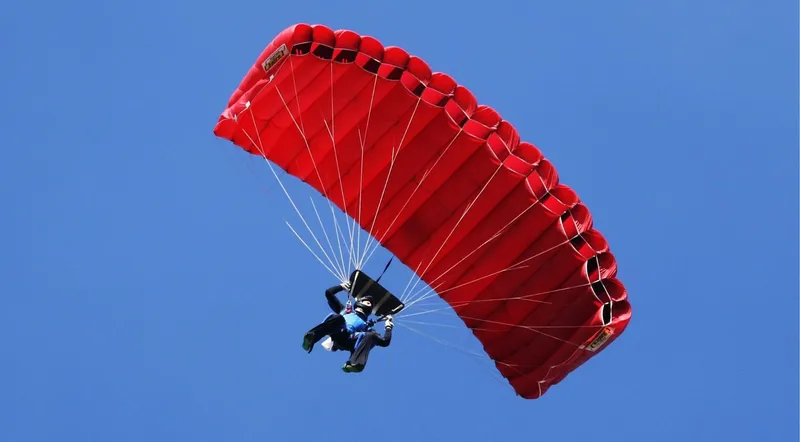
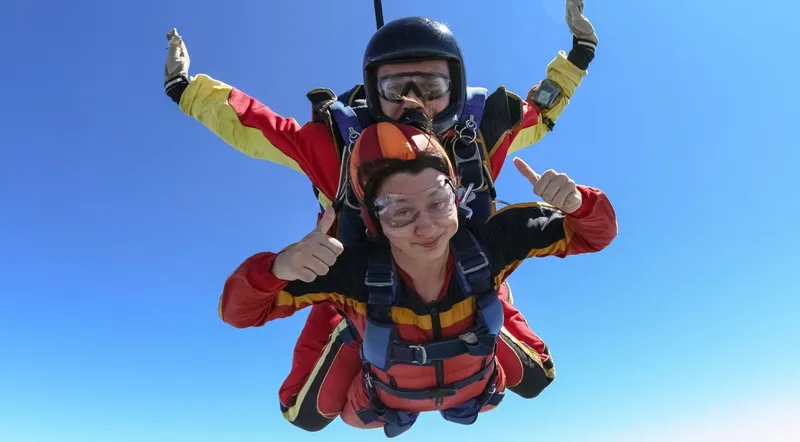
For the standard tandem paragliding flight. Skydiving includes the jump, briefing, equipment and tandem master.
Every flight here is operated by established, licensed Interlaken companies — we point you to the ones with the strongest records and the clearest pricing.
Tandem pilots hold the Swiss licence regulated on behalf of FOCA, with reserve parachutes on every rig and gliders built to an eightfold load. See our full guide to paragliding safety, pilots and reserve parachutes for how it all works.
The featured paragliding flight lands in Höhematte park, a few minutes' walk from the promenade — no long transfer back at the end.
Nerves peak at the strap-in; the glide itself is smooth and quiet. People who fear heights routinely love it — there's no ground underfoot. New to it? Our first-time flyer's guide covers exactly what to expect.
Reserve now and pay later, with free cancellation up to 24 hours before — essential when weather can shift your slot.
They are different experiences, not interchangeable. Here's the honest side-by-side.
| Tandem Paragliding | Airplane Skydiving | |
|---|---|---|
| Best for | Scenery, first-timers, nervous flyers | Thrill-seekers, bucket-list adrenaline |
| Time in the air | 10–20 minutes of gliding | ~45 sec freefall + 5–7 min canopy |
| How it feels | Calm, floating, surprisingly peaceful | Extremely intense, then a scenic glide |
| Price (from) | ~$221 (CHF 170–230) | ~$523 (CHF 425–430) |
| Lands at | Höhematte park, central Interlaken | Reichenbach airfield (20–30 min out) |
The short version: if your budget covers one flight, most visitors get more from the paragliding view and airtime. Book the skydive if the freefall itself — not the scenery — is the reason you're going up. For the full breakdown, read our guide to skydiving vs paragliding in Interlaken, or see how much skydiving costs here.
"A must-do in Switzerland. You get the best views and from such a unique way. Skywings did a great job with easy pickup and drop-off."Verified paragliding guest · June 2026
"I had an amazing experience flying with my pilot Priska. She made sure I was comfortable before and during the flight — very skilled."Rie · paragliding · June 2026
"Absolute must-do if you're visiting Interlaken. Breathtaking views on the way up and down, with an instructor walking you through each step."Verified skydiving guest · June 2026
"Everyone working there was very kind and friendly. The experience was breathtaking; words cannot describe it. I definitely recommend it!"Verified skydiving guest · June 2026
Reviews are paraphrased from verified GetYourGuide bookings (4.9/5 across 2,630+ paragliding and 610 skydiving reviews) and shortened for length.
Interlaken is ~2 hours by direct train from Zurich and Lucerne and ~2.5–3 hours from Geneva. Paragliding meets in town; the airplane skydive is at Reichenbach, ~20–30 minutes away. Our guide to getting to Interlaken covers train times and whether a day trip is realistic.
April–October is most reliable; May and September are the sweet spot for mild weather and smaller crowds. Mornings are calmest; midday brings stronger thermals and a more dynamic ride. See our best time to book & fly guide for the full picture.
Closed-toe shoes and warm layers — it's cooler aloft. Paragliding max weight 80–90 kg (min age ~5); skydiving age 12+, 40–105 kg, min height 1.4 m. You must run a few steps to launch.
Weather, not equipment, is the main variable — flights are routinely postponed or refunded. Book early in your trip so a poor-weather day still leaves a backup. Free cancellation up to 24 hours before. See our free cancellation & rebooking guide for how it works in practice.
No surprises on the day — here's the straight talk most listings skip.
Low cloud, rain or wind can cancel flights or obscure the view. The biggest review complaint is paying to fly in cloud — reschedule rather than fly on a poor day.
Photo and video are not in the base price (about CHF 40 for paragliding, more for skydiving) and you can't film yourself — phones and selfie sticks aren't allowed in the air.
A skydive is about $523 for ~45 seconds of freefall; paragliding is about $221 for 10–20 minutes of airtime. The paragliding flights cluster tightly — the cheapest sits $14 under the one most people book, and neither price includes the photos. Our guide to what paragliding in Interlaken costs walks the whole ladder.
Paragliding take-off needs a short run down a slope; landing is usually a soft few steps. No fitness feat, but not entirely hands-off either.
The single biggest mistake is booking your final day. Schedule day one or two so a weather postponement still has a backup slot.
In July–August, morning slots can sell out days to a week ahead. Reserve in advance — with free 24-hour cancellation you keep flexibility.
Yes — for most first-time flyers it is the highlight of the trip. A standard tandem flight is 10–20 minutes for about $221, launches from Beatenberg/Amisbühl, and lands in Höhematte park in the centre of town, with the Eiger, Mönch and Jungfrau on one side and Lakes Thun and Brienz on the other. It is calmer and far cheaper than skydiving, and you actually have time to take in the view.
Choose paragliding for scenery, airtime and value; choose skydiving for the adrenaline. Paragliding gives 10–20 minutes of calm gliding for around $221 and lands in town. Skydiving is a ~45-second freefall from 4,000 m (13,000 ft) at about $523, landing at Reichenbach. If your budget covers one, most visitors get more from the paragliding view; book skydiving if the freefall itself is the goal. Our full skydiving vs paragliding guide compares cost, thrill and safety in detail.
Yes, with a licensed operator. Tandem pilots must hold the SHV/FSVL Swiss licence regulated on behalf of FOCA, every rig carries a reserve parachute, and gliders are built to withstand at least an eightfold load. The main variable is weather, not equipment — a good operator postpones or cancels rather than flying into cloud, which is itself a sign they take safety seriously. Our full guide to paragliding safety, pilots and reserve parachutes covers exactly how pilot certification and equipment redundancy work.
Standard tandem paragliding is about $221 (roughly CHF 170–230) for 10–20 minutes. Airplane tandem skydiving from 4,000 m is about $523 (roughly CHF 425–430). Both base prices exclude photo and video, which are an on-site add-on (about CHF 40 for paragliding; CHF 140–230 for skydiving). For a full breakdown of jump prices and what drives them, see our Interlaken skydiving cost guide.
The airplane tandem jump climbs to about 4,000 m (13,000 ft), with roughly 45 seconds of freefall at around 200 km/h, followed by a 5–7 minute canopy ride down to the Reichenbach airfield. For the full time breakdown — including how this compares to paragliding airtime and total door-to-door commitment — see our guide to how long paragliding and skydiving flights last in Interlaken.
Yes, especially June–September, on weekends and in sunny spells. Book paragliding several days to a week ahead in peak summer and skydiving as early as you can. Crucially, schedule your flight for the first or second day of your trip, not the last — weather can postpone it, and an early slot leaves a backup day. Free cancellation up to 24 hours before applies to the bookings here.
April–October has the most reliable weather and visibility; May and September are the sweet spot for mild conditions and smaller crowds. Mornings are usually calmest; midday brings stronger thermals and a more dynamic ride. Paragliding runs year-round (shorter winter days), while airplane skydiving runs daily April–October and on request in winter. Our guide to the best time to book & fly in Interlaken breaks down the best season, days and time of day.
Paragliding here has a maximum weight of 80–90 kg depending on the time slot, with a minimum age around 5 and the ability to run a few steps at launch. Airplane skydiving requires age 12+ (with parental consent under 18), a minimum 40 kg and maximum 105 kg, and a minimum height of 1.4 m. Our full guide to weight and age limits in Interlaken breaks down every threshold.
Wear closed-toe shoes and warm layers — it is cooler aloft than in town; operators lend boots and jackets if needed. Personal phones, selfie sticks and cameras are not allowed in the air for safety, so footage is filmed by the pilot or instructor and sold as a separate photo/video package.
No experience is needed — both are tandem flights with a licensed pilot or instructor. The nerves peak on the walk to the launch and the strap-in; once you are flying, paragliding becomes surprisingly calm, and people who are afraid of heights routinely love it because there is no ground underfoot. For skydiving the anticipation is the hardest part; most describe calm after the exit. Our complete paragliding guide walks through the whole flight, step by step, and our first-time flyer's guide covers exactly what to expect if you're nervous.